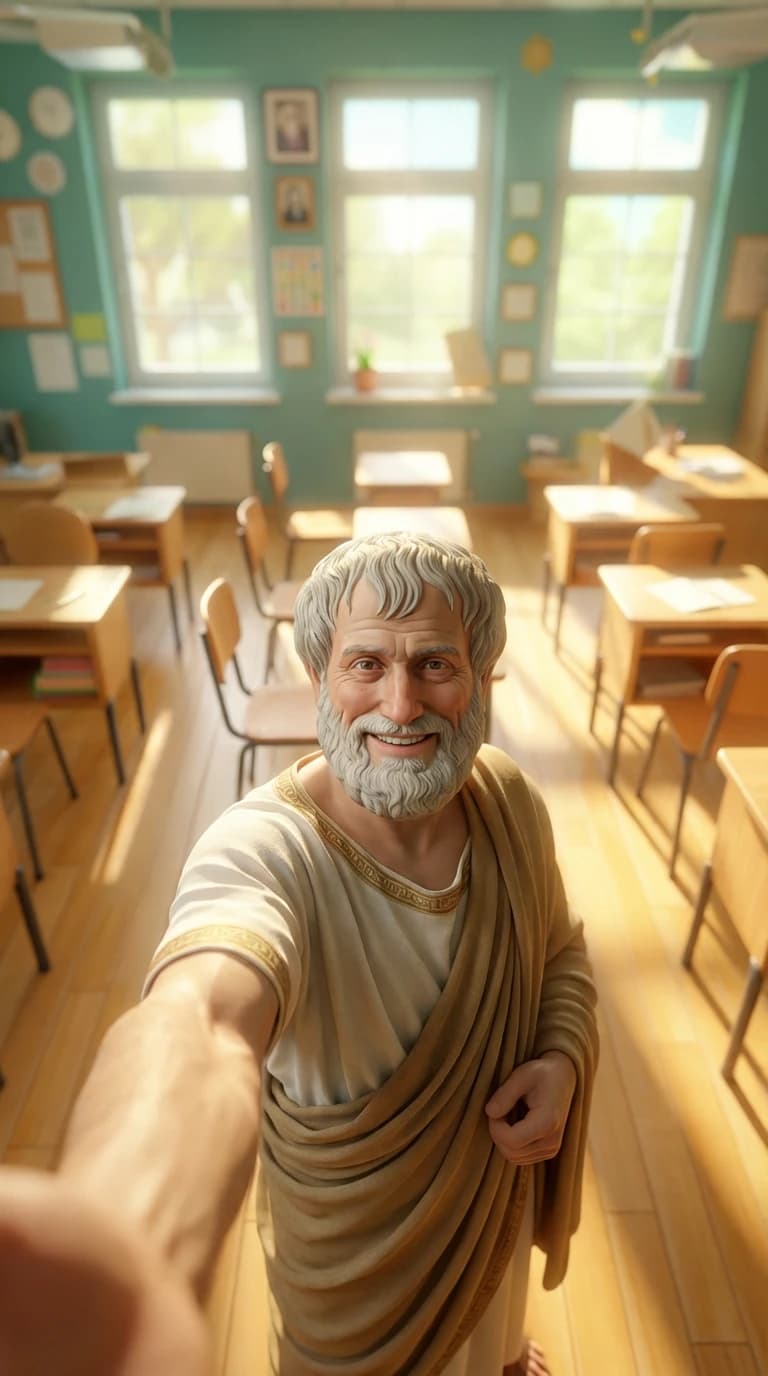
Aristotle influenced almost all areas of Western thought, from science to philosophy, and is considered one of the greatest thinkers in history.
The story
Once upon a time, long, long ago, in Ancient Greece, a boy was born who would change the way people think about the world.
Once upon a time, long, long ago, in Ancient Greece, a boy was born who would change the way people think about the world. His name was Aristotle, and he was born in the small town of Estagira, in a region known as Macedonia, in the year 384 BC. From a very early age, Aristotle showed an incredible curiosity. He spent hours observing everything around him: plants, animals, and even the stars
Every day, at 17, after his father's death, Aristotle moved ...
Every day, at 17, after his father's death, Aristotle moved to Athens, the great city that was the center of learning in Greece.
There, he went to study at Plato's famous Academy. Plato was a highly respected philosopher, and his school attracted the best thinkers from all over Greece.
Aristotle was enchanted by what he learned at the Academy. Plato taught that the real world was only an imperfect copy of a world of perfect ideas that we could only understand with the mind.
Every day, Aristotle participated in debates with his peers and teachers. He thought deeply about Plato's ideas, but over time he began to form his own opinions.
He believed that the world we see and feel is real and that we must study it to understand how it works. For Aristotle, observing the real world was the key to knowledge. He wanted to learn not only about what was in the mind but also about what existed in nature.
One Day, After Plato's Death, Aristotle Decided It Was Time to Follow His Own Path
One day, after Plato's death, Aristotle decided it was time to follow his own path. He left Athens and spent many years traveling throughout Greece and beyond, always observing the world around him. Aristotle studied plants, animals, and human behavior. He wanted to understand how everything was connected and what the purpose of each living being was. He believed that every thing in the world had a reason for existing, and his mission was to discover what that was. It was during this time that Aristotle began writing his own books on philosophy, science, and politics. His studies covered a wide range of subjects, from biology to astronomy, including ethics and politics. Aristotle observed animals, classified plants, and tried to understand the laws of nature. He said that the key to understanding the world was to observe carefully and ask questions.
Aristotle observed animals, classified plants, and tried to understand the laws of nature. He said that the key to understanding the world was to observe carefully and ask questions.
Because of this, soon the fame of Aristóteles spread throughout Greece, and...
Because of this, soon the fame of Aristóteles spread throughout Greece, and one day he was invited by a very important king. King Filipe of Macedonia asked Aristóteles to become the tutor of his son, Alexandre. Aristóteles accepted the task, and thus began to teach the young prince. Alexandre was a very intelligent and ambitious student, and Aristóteles taught him about philosophy, ethics, science, and politics. He wanted Alexandre to use his power for good, ruling with wisdom and justice. The two spent several years together, and Alexandre absorbed all the knowledge Aristóteles offered him. When Alexandre grew up, he became the famous Alexandre, the Great, who conquered vast territories and brought Greek culture to many parts of the world. Although Alexandre became a great conqueror, he never forgot Aristóteles' teachings about wisdom and fair leadership.
Because of that, after his time as Alexander's tutor, Aristotle returned to...
Because of that, after his time as Alexander's tutor, Aristotle returned to Athens and founded his own school, the Lyceum. Unlike Plato's Academy, the Lyceum was a place where students learned about the world through direct observation. Aristotle and his students spent hours walking
Finally, at the end of his life, Aristotle had written more than 200 works...
Finally, at the end of his life, Aristotle had written more than 200 works on almost every imaginable topic: philosophy, biology, physics, ethics, politics, art, and even theater. His ability to think deeply and observe the world with care made him one of the greatest philosophers in history. His school, the Lyceum, became one of the most important centers of learning in the ancient world, and his teachings continued to be studied for generations. Even after Aristotle’s death, his legacy endured. His books were read and translated into many languages, and his ideas influenced philosophers, scientists, and thinkers for centuries. Aristotle is remembered as the “father of logic” and as one of the first scientists in history. He showed us that the best way to understand the world is through observation and curiosity. He never stopped asking questions, and that’s why his ideas remain alive to this day.