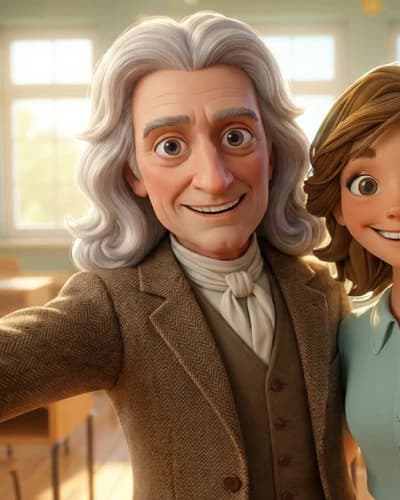
Newton revolutionized science by formulating the laws of gravity and motion, and significantly contributed to mathematics with the development of calculus.
The story
Once Upon a Time, in 17th Century England, a Brilliant Young Man Named Isaac Newton
Once upon a time, in 17th‑century England, there was a brilliant young man named Isaac Newton. Newton was not an ordinary boy; he had an insatiable curiosity about the world around him. He loved observing nature and wondered how and why things happened. From a young age, he already showed a deep interest in understanding the mysteries of the universe. While other children played, Newton preferred to spend hours trying to discover how objects and phenomena worked around him. He was so dedicated to his learning that he often forgot to do simple things, like eat and rest. This determination and focus were essential to his future discoveries.
Every day, Isaac Newton dedicated himself to his studies with incredible intensity...
Every day, Isaac Newton devoted himself to his studies with incredible intensity. He read books on mathematics and physics, conducting experiments in the small laboratory he had set up in his home.
Newton was not just a scholar; he was a true explorer of knowledge. Every new discovery or insight was a great victory for him.
He used to jot down his observations in a diary, where he recorded all his ideas and theories. These diaries became essential to the development of modern science.
Isaac believed that to understand the universe, one had to observe, test, and repeat experiments countless times. And so he did, day after day, always searching for answers to the questions that circled his curious mind.
One Day, While Newton Rested Under the Shade of a Large Apple Tree in His Garden
One day, while Newton was resting under the shade of a large apple tree in his garden, something unexpected happened. A bright red apple fell from the branch and landed right beside him. Instead of ignoring this simple event, Newton became intrigued. He wondered, “Why does the apple always fall down? What makes it follow that direction and not another?” That was how Newton began to formulate his ideas about gravity, a concept that would forever change the way we understand the world. He realized that the force pulling the apple to the ground was the same force that keeps the planets orbiting the sun, a revolutionary discovery. Because of that moment, Newton formulated the Law of Universal Gravitation, which explains how all objects in the universe, big or small, attract each other with a force proportional to their masses. This discovery not only explained the falling apple but also allowed Newton to develop the laws of motion, which describe how and why objects move. These laws are still used today by scientists and engineers to understand the motion of everything from a rolling ball to planets moving in space. Newton devoted himself to proving his theories through precise experiments and calculations, and his work ultimately revolutionized the science we know today.
Because of this, Newton was recognized as one of the greatest scientists of all time.
Because of this, Newton was recognized as one of the greatest scientists of all time. His work *Principia Mathematica* is considered one of the most important ever written in the history of science. It laid the foundations for modern physics, and even today its laws and theories are taught in schools and universities around the world. Newton also made important contributions in other areas, such as optics, where he discovered that white light is composed of all the colors of the rainbow, and in mathematics, where he developed calculus, an essential tool for science and engineering. Newton showed us that with curiosity, dedication, and hard work, it is possible to unravel the mysteries of the universe.
Recognition and New Challenges
Because of that, Isaac Newton was invited to join the Royal Society, the most important community of scientists in England. There, he met other great thinkers, exchanged ideas, and began teaching at the University of Cambridge, where his classes were so exciting that students were eager to learn about light, motion, and calculus.
Finally, Isaac Newton left us a legacy that continues to inspire scientists...
Finally, Isaac Newton left us a legacy that continues to inspire scientists and students to this day. He proved that study and observation are essential to understanding the world around us. His discoveries paved the way for many others that followed, and his name has become synonymous with genius and innovation.
Newton taught us that with patience and perseverance, we can achieve great discoveries and contribute to the advancement of human knowledge.
Thus, Isaac Newton, the Father of Modern Physics, is remembered not only for his incredible contributions to science but also for the example that curiosity and determination can change the world.