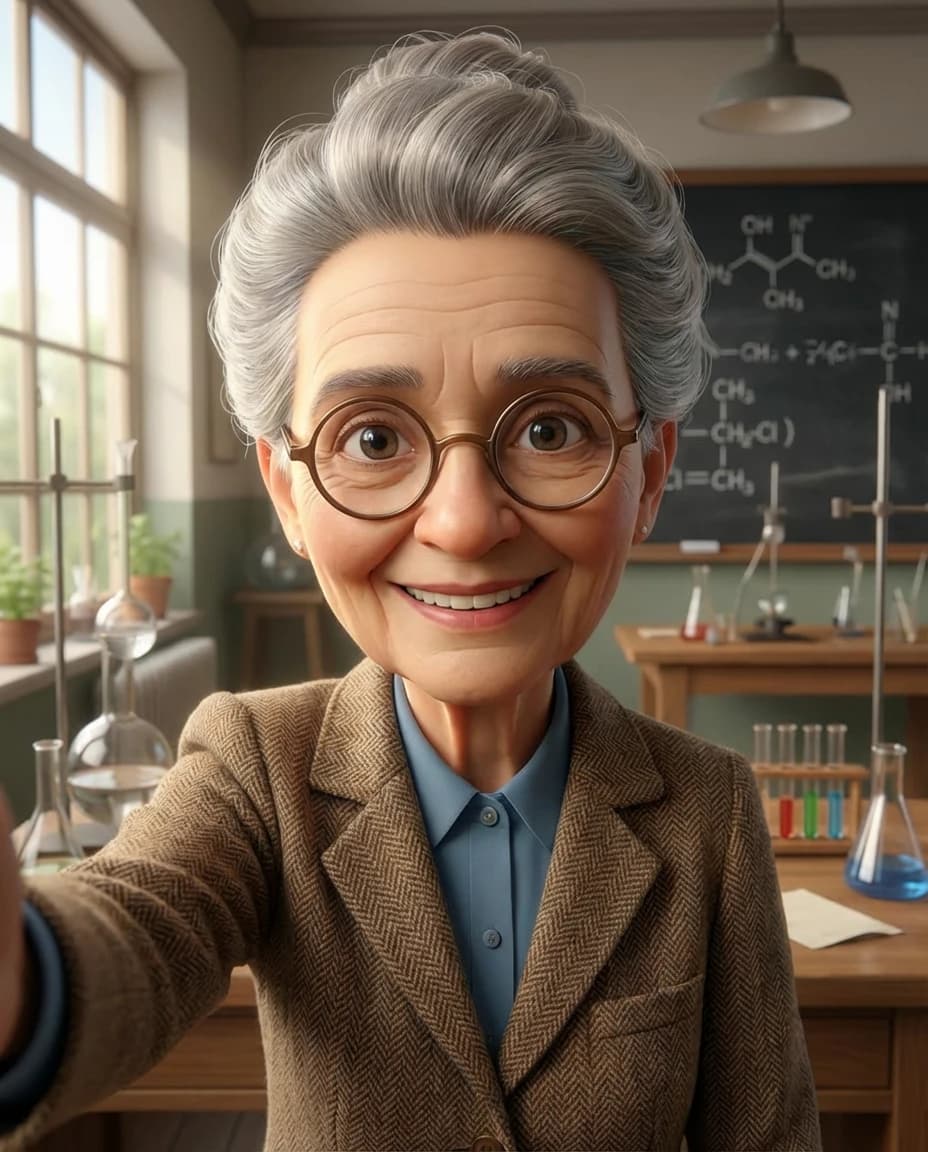
Marie Curie revolutionized the field of science with her research on radioactivity, which not only led to significant advances in physics and chemistry but also to the creation of medical treatments, such as radiotherapy, used to combat cancer.
The story
Once upon a time, Marie Curie was born on November 7, 1867, in the city of Warsaw, Poland, which at the time was under the rule of the Russian Empire.
Once upon a time, Marie Curie was born on November 7, 1867, in the city of Warsaw, Poland, which at the time was under the rule of the Russian Empire. Her birth name was Maria Skłodowska, and from a very young age she stood out as an extremely curious child interested in science. Her father, who was a professor of physics and mathematics, constantly encouraged her to study and pursue the path of knowledge. But, despite her desire to learn, Poland was going through difficult times, and girls did not have the same educational opportunities as boys. This made young Maria face many challenges from early on. But nothing stopped her from dreaming big. With every book she read, Maria imagined herself in laboratories, discovering amazing things about the world around her. She dreamed of becoming a scientist and, perhaps one day, helping to change the world with her discoveries.
Every Day, Even With All the Hardships, Maria Never Gave Up Her Dream
Every day, even with all the hardships, Maria never gave up her dream. At 24, she made a brave decision: to move to Paris, France, to continue her studies at one of the world's most respected universities, the Sorbonne. There, she adopted the name everyone knows today: Marie Curie.
Every day, Marie devoted herself intensely to her studies. Her living conditions were very difficult; she lived in a cold, poorly lit room with few resources to get by. Often she went hungry and cold, but none of that dampened her enthusiasm for learning.
Marie was a brilliant student and, despite the hardships, graduated in physics and mathematics, always
One day, Marie and Pierre were fascinated by a strange phenomenon discovered...
One day, Marie and Pierre were fascinated by a strange phenomenon discovered by another scientist named Henri Becquerel. He noticed that some materials emitted an invisible energy, which he called radiation. Marie was so intrigued that she decided to devote her research to understanding more about this new form of energy. That is how, in 1898, Marie Curie made an extraordinary discovery. While studying the mineral called uraninite, also known as pitchblende, she found two chemical elements that had not been known before: radium and polonium. These elements emitted intense radiation, much stronger than uranium. Marie gave the radiation the name "radioactivity," and her research opened a new field of study in physics and chemistry. But her journey was only just beginning. Marie faced enormous challenges. Many scientists did not believe her discoveries because she was a woman. Moreover, working with radioactive materials was dangerous, and at the time, no one knew how harmful it could be to health. Nevertheless, Marie did not stop. She and Pierre continued their experiments, working tirelessly in a small makeshift laboratory with rudimentary equipment.
Because of this, in 1903, Marie's work was grandly recognized
Because of this, in 1903, Marie's work was grandly recognized. She, Pierre Curie, and Henri Becquerel received the Nobel Prize in Physics for the discovery of radioactivity.
Marie Curie became the first woman in history to win a Nobel Prize, an extraordinary achievement at a time when women were rarely seen in prominent scientific roles.
However, despite the recognition, Marie continued to face obstacles. Pierre, who had always been her greatest support, tragically died in an accident in 1906, leaving Marie alone with two young daughters. This was one of the most difficult moments of her life.
Even devastated by the loss, she decided to continue her scientific work, in honor of Pierre's legacy and the love they shared for science.
Gradually, Marie carved out her place as one of the world's most important scientists. She became the first woman to lecture at the Sorbonne University, a milestone that opened doors for many other women.
Because of that, Marie's determination didn't stop there
Because of that, Marie's determination didn't stop there. In 1911, she was awarded her second Nobel Prize, this time in Chemistry, for her discoveries about radium and polonium. To this day, Marie Curie is the only person to have received the Nobel in two different scientific fields. Her studies on radioactivity not only brought huge advances to physics and chemistry, but also paved the way for the development of revolutionary medical treatments. Radiotherapy, still used today to treat cancer, is one of Marie Curie's most important legacies. Her research has saved and continues to save millions of lives around the world. In addition to her scientific work, Marie Curie was a great advocate for peace and used her fame and influence to help during World War I. She organized mobile radiology units, known as the "Little Curies," which helped save the lives of many wounded soldiers by using radioactivity to detect bullets and fractures.
Finally, Marie Curie Died in 1934
Finally, Marie Curie died in 1934 at the age of 66, a victim of illnesses caused by long exposure to radiation. At that time, people did not yet know the dangers of such materials. Even so, her legacy lives on today.
Marie Curie's discoveries changed science, and she is remembered as one of the brightest and bravest figures in history. Her life shows that determination, love of knowledge, and courage can change the world.
She not only opened doors for women in science, but also left a lasting impact that continues to benefit humanity. Today, Marie Curie inspires scientists, both men and women, around the world. Her name is a synonym for scientific excellence, and her legacy reminds us that with effort and passion, any dream can be achieved, no matter the obstacles.