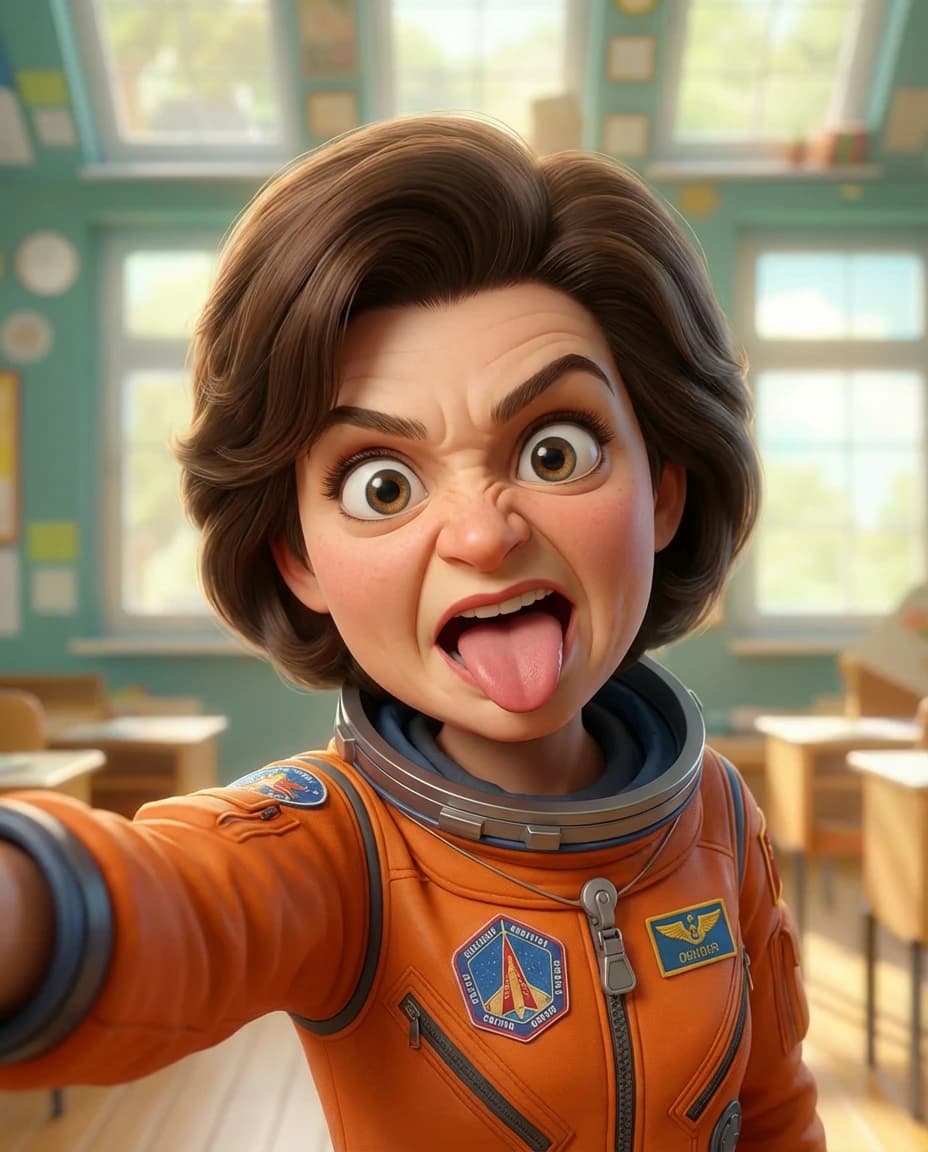
Tereshkova paved the way for women in space exploration and was a symbol of gender equality, showing that women can also play significant roles in space sciences.
The story
Once there was a girl who watched the sky
Once, in a village in Russia, there was a girl named Valentina Tereshkova. She liked to watch the sky and imagine what it would be like to leave Earth.
People around her did not say a girl could fly a spacecraft. Valentina kept that wish and kept studying.
Every day she trained to go farther
Every day Valentina practiced parachuting and learned about airplanes. The training was tiring, but she came back the next day.
While many people thought space was only for men, she prepared as if the door might open.
Until one day the call arrived
Until one day Valentina was chosen for the group of women who might fly to space. It was 1962, and the training grew even harder.
She learned to live inside a small capsule, to bear the force of launch, and to trust her own calm.
Because of that, Vostok 6 left the ground
Because of that, on June 16, 1963, Valentina launched on Vostok 6. She became the first woman to travel alone around Earth.
From up there, the planet looked like one home, without the borders people draw on maps.
Because of that, other girls looked up
Because of that, girls in many countries began to say out loud that they wanted to be scientists, pilots, and astronauts too.
Valentina's flight did not last forever, but the question she left behind remains: who decides how far a person can go?
Until Finally: A Lasting Legacy
Valentina received numerous awards, including the Soviet Union's Gold Medal and the title of Heroine of the People. She continues to be an inspiration for children and adults.
Today, her name is remembered in monuments, books, and television programs, reminding us that the sky has no limits for those who have courage and determination.